
You're smart. You know what needs doing. You even know it would take less time than you've spent avoiding it. So why do you procrastinate anyway? If you've asked yourself that at 1 a.m. with a deadline a few hours away, here's the real answer.
Procrastination is an emotion problem, not a time problem
For years, the standard advice was about time: better calendars, better to-do lists, better apps. But plenty of people with beautiful calendars still procrastinate. That's because the problem usually isn't knowing when to do the task. It's how the task makes you feel when you sit down to do it.
Psychologists Fuschia Sirois and Timothy Pychyl wrote a widely cited paper describing procrastination as the priority of short-term mood repair over the pursuit of intended actions. Translation: when a task makes you feel bad, avoiding it makes you feel better, right now. Your brain is very good at learning that trade.
The catch is that the relief is short and the bill comes later, usually with interest. The task is still there, now with less time and extra guilt. And guilt is another bad feeling, which makes the task even less appealing next time. That's the loop.
The most common causes of procrastination
"Bad feeling" is a big umbrella. Here are the specific ones that tend to hide underneath. See which one sounds like you.
- Boredom. The task is dull, and your brain would rather do anything else. Expense reports, laundry, data entry.
- Fear of doing it badly. If you never start, nobody can judge the result, including you. This is perfectionism's favorite trick.
- Overwhelm. The task is so big or so tangled that you can't see where it begins, so you don't.
- Vagueness. "Figure out insurance" isn't an action. When the next step is unclear, the brain stalls.
- Resentment. Someone else assigned it, you didn't agree, and some part of you is quietly on strike.
- Exhaustion. Sometimes you aren't procrastinating. You're out of fuel. That's a different problem with a different fix.
Naming the feeling sounds too simple to matter, but it changes what you do next. Boredom needs a timer and a reward. Fear needs a deliberately bad first draft. Overwhelm needs a smaller first step. Vagueness needs a clear next action. Exhaustion needs rest.
Why "trying harder" makes it worse
When you're stuck, it's tempting to call yourself lazy and push harder. The problem is that self-criticism is one more painful feeling attached to the task, so avoiding the task now protects you from two bad feelings instead of one.
Being kind to yourself about procrastination isn't letting yourself off the hook. It's lowering the emotional cost of starting so starting becomes possible. "I've been avoiding this because it's boring and I'm tired, and that's human. What's the smallest piece I can do?" is a far more useful thought than "What is wrong with me?"
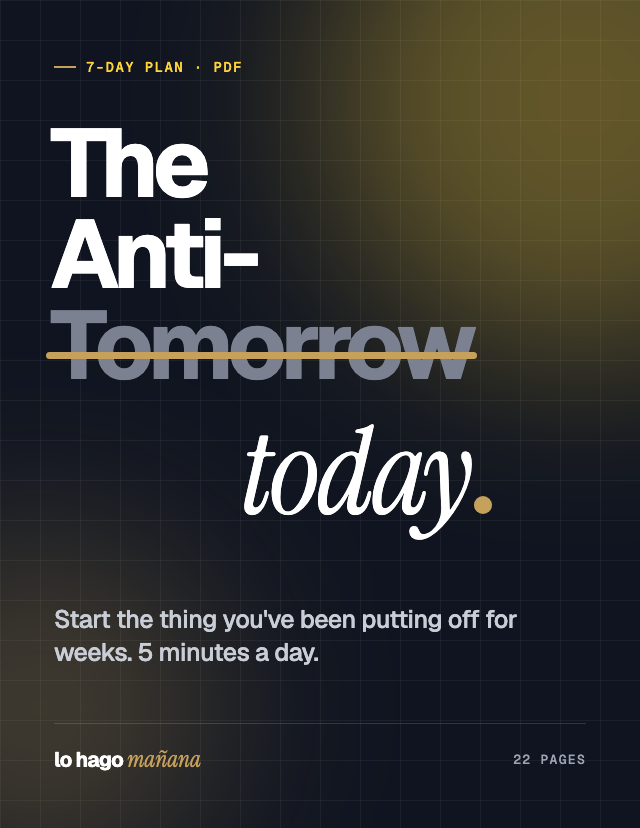
The Anti-Tomorrow Plan
Day 1 of the plan is The Activation Framework: why you freeze in front of tasks you actually want to do. Then six more short chapters turn that understanding into small daily habits. A 25-page PDF, one chapter a day, $9.99. See what's inside the 7-day plan.
Get the 7-day plan for $9.99 →Procrastination and ADHD
Everyone procrastinates. For some people, though, getting started is a constant struggle no matter how much they care. People with ADHD often describe tasks that aren't interesting, new, or urgent as feeling almost impossible to begin, even when they really want to. If that's familiar, our article on ADHD procrastination goes deeper, and ADHD task paralysis covers the "frozen in place" version.
Only a qualified professional can tell you whether ADHD or something else, such as anxiety, depression, or burnout, is part of the picture. If procrastination is seriously affecting your work, money, health, or relationships, that conversation is worth having.
5 fixes that work on the feeling, not the schedule
If the root is emotional, the fixes need to work on the feeling, not just the schedule. The ones that tend to help most:
- Make the first step tiny. A small step brings up a small feeling. "Open the file" is easier to face than "finish the report." This is the core idea in how to start a task you've been avoiding.
- Use a short timer. Committing to five minutes is far less scary than committing to "until it's done." See the 5-minute rule.
- Separate deciding from doing. Pick tomorrow's one task the night before, so in the morning there's nothing left to negotiate with.
- Start before your phone. Your phone is the most convenient mood-repair machine ever invented. Doing a small step first keeps it from winning by default.
- Plan for bad days. Some days you'll have almost nothing. Decide in advance what the "minimum version" of your day looks like, so a bad day doesn't become a lost week.
For a full list, read how to stop procrastinating: 9 shame-free tips.
Knowing why is step one. Practice is step two.
Knowing why you procrastinate is a relief. It explains years of "why can't I just do it?" But insight on its own rarely changes behavior. What changes behavior is practicing small, repeatable actions until starting feels normal.
That's why we built The Anti-Tomorrow Plan, a 7-day plan for people who put things off. It begins with why you freeze, then gives you one small daily habit at a time: a morning ritual, Brain Bites for shrinking tasks, an evening debrief, a weekly reset, and an Emergency Toolkit for the days nothing works.
Not sure where you land? Take the free 2-minute procrastination test. It's a quick self-check, not a diagnosis, and it sends you Day 1 of the book free by email. You'll know a little more about your own patterns, and you'll have something to start with today. Not tomorrow. Today.
Frequently asked questions
Why do I procrastinate even when I want to do something?
What are the main causes of procrastination?
Is procrastination linked to emotions?
Is procrastination a mental health problem?
I'll Do It Today creates educational tools and content for people who put things off, with or without ADHD. This article is for information only and is not medical advice, diagnosis, or treatment. If you're worried about your focus, mood, or health, please talk to a qualified healthcare professional.