
You've read the tips. You've watched the videos. The task is still sitting there. Some people need a pep talk. Others need a pen, a piece of paper and someone to say "fill this in." If you're the second kind, this free procrastination workbook is for you. Use it right now, no download or email required.
Why a worksheet helps when your brain won't
When a task is stuck in your head, it's foggy and enormous. Putting it on paper helps in three ways. The task gets smaller and more concrete. The feeling behind it comes into the open. And you get something to do that isn't the task but clearly moves you toward it.
Procrastination is often less about time and more about avoiding how a task makes you feel. Researchers Fuschia Sirois and Timothy Pychyl describe it as putting short-term mood repair ahead of what we intend to do. A worksheet works on that directly. It turns "ugh" into words, and words are much easier to deal with than "ugh." (More on that in why do I procrastinate.)
Grab a pen, a notebook, the back of an envelope, whatever's nearby. Fancy stationery is optional. Honestly, shopping for it can be a procrastination move of its own.
Worksheet 1: The avoidance inventory
Write down everything you've been putting off. Don't sort it, don't judge it, just empty your head. Then, next to each item, answer:
- How long have I been avoiding this? (A day, a week, "don't ask.")
- What happens if I keep avoiding it for one more week?
- Circle the one item that would bring the most relief if it were done.
That circled item is the only one you work on for the rest of this workbook. One. Not five.
Worksheet 2: The feeling behind it
For your circled task, finish these sentences:
- "When I think about starting this, I feel ___."
- "The part I'm dreading most is ___."
- "If it went badly, I'm afraid that ___."
- "If a friend told me they were avoiding this, I'd tell them ___."
The last one matters. Most of us are far kinder to friends than to ourselves. Borrow that voice.
Worksheet 3: Shrink it (the first-step ladder)
Write the task at the top of the page. Underneath, write a smaller version. Underneath that, an even smaller one. Keep going until the bottom rung is so small it feels a little silly. For example:
- File my taxes
- Gather my tax documents
- Find last year's return
- Open the folder where it might be
- Stand up and walk to the filing cabinet
The bottom rung is your first step. Do it in the next ten minutes. If you want more on this technique, see how to start a task you've been avoiding.
The Anti-Tomorrow Plan
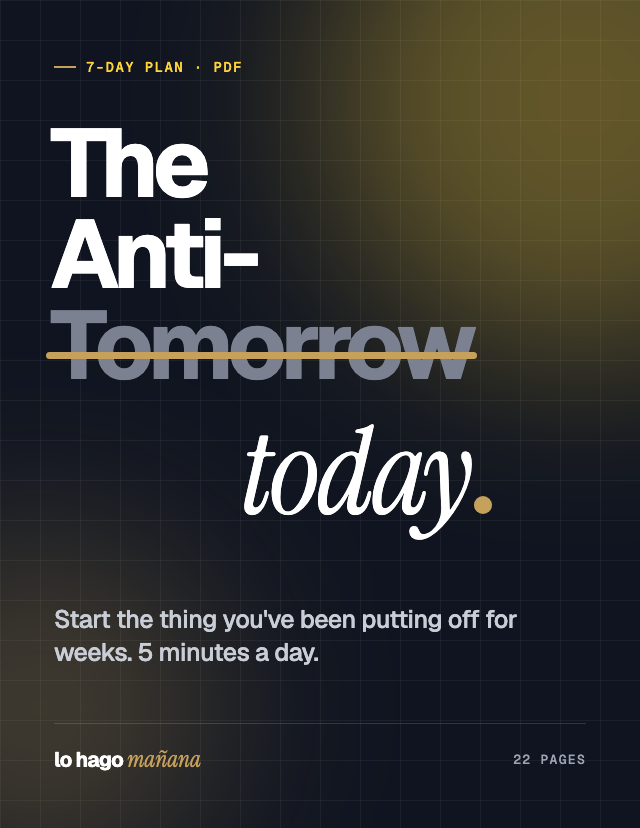
These prompts are a taste. The Anti-Tomorrow Plan turns them into a 7-day system: one short chapter a day, from The Activation Framework on Day 1 to the Emergency Toolkit on Day 7. A 25-page PDF you can print or read on your phone, $9.99 one time. See what's inside the 7-day plan.
Get the 7-day plan for $9.99 →Worksheet 4: The five-minute contract
Write this out and fill in the blanks:
"Today at ___ (time), I will work on ___ (first step) for five minutes. When the timer rings, I'm allowed to stop. If I keep going, that's a bonus, not a requirement."
Sign it if you want to feel official. The point is that five minutes is small enough that your brain stops arguing. Read more in the 5-minute rule for procrastination.
Worksheet 5: The evening debrief
Before bed, take five minutes and answer three questions:
- What did I actually do today? (Count small things. They count.)
- What did I avoid, and what got in the way?
- What is my one task for tomorrow, and what's its first step?
Picking tomorrow's task tonight means morning-you doesn't have to decide anything. Morning-you just has to start.
Worksheet 6: The Sunday reset
Once a week, take ten minutes for three questions:
- What went better this week than last week?
- What keeps getting pushed, and does it still matter?
- What's the one thing that would make next week feel lighter?
If something has been pushed four weeks in a row, it either needs a much smaller first step, someone else's help, or permission to be deleted. All three are valid.
How to use this workbook without it becoming another abandoned project
Many of us have a drawer of half-used planners. (If that's you, why planners don't stick explains a lot.) To keep this from joining them:
- Do one worksheet, not all six. Worksheet 3 is a great place to start.
- Use whatever paper is closest. Waiting for the perfect notebook is a delay tactic.
- Never miss twice. Skip a day? Fine. Just don't skip two in a row.
- Keep it ugly. Nobody grades this. Crossed-out words mean you're working.
Want the printable procrastination plan?
These six prompts are enough to get you moving today. If you want them organized into a full, step-by-step program, that's what The Anti-Tomorrow Plan, our printable 7-day procrastination workbook is for. It's a 25-page PDF with one short chapter a day: Day 1 explains why you freeze, Day 2 is a 5-minute morning ritual before your phone, Day 3 is Brain Bites (shrinking a task until it starts itself), Day 4 is the evening debrief, Day 5 the weekly reset, Day 6 the Momentum Blueprint, and Day 7 an Emergency Toolkit for impossible days.
It works with any planner or a plain sheet of paper, and there's a 30-day refund if it isn't for you. Not ready to buy anything? Take the free 2-minute procrastination test first. It's a self-check, not a diagnosis, and it emails you Day 1 of the book free. Then pick up your pen and start with Worksheet 3.
Looking for more ideas you can use alongside these pages? Try how to stop procrastinating.
Frequently asked questions
What is a procrastination workbook?
Do procrastination worksheets actually help?
Can I use these worksheet prompts for free?
Is there a printable procrastination plan?
I'll Do It Today creates educational tools and content for people who put things off, with or without ADHD. This article is for information only and is not medical advice, diagnosis, or treatment. If you're worried about your focus, mood, or health, please talk to a qualified healthcare professional.